Opens in a new tab
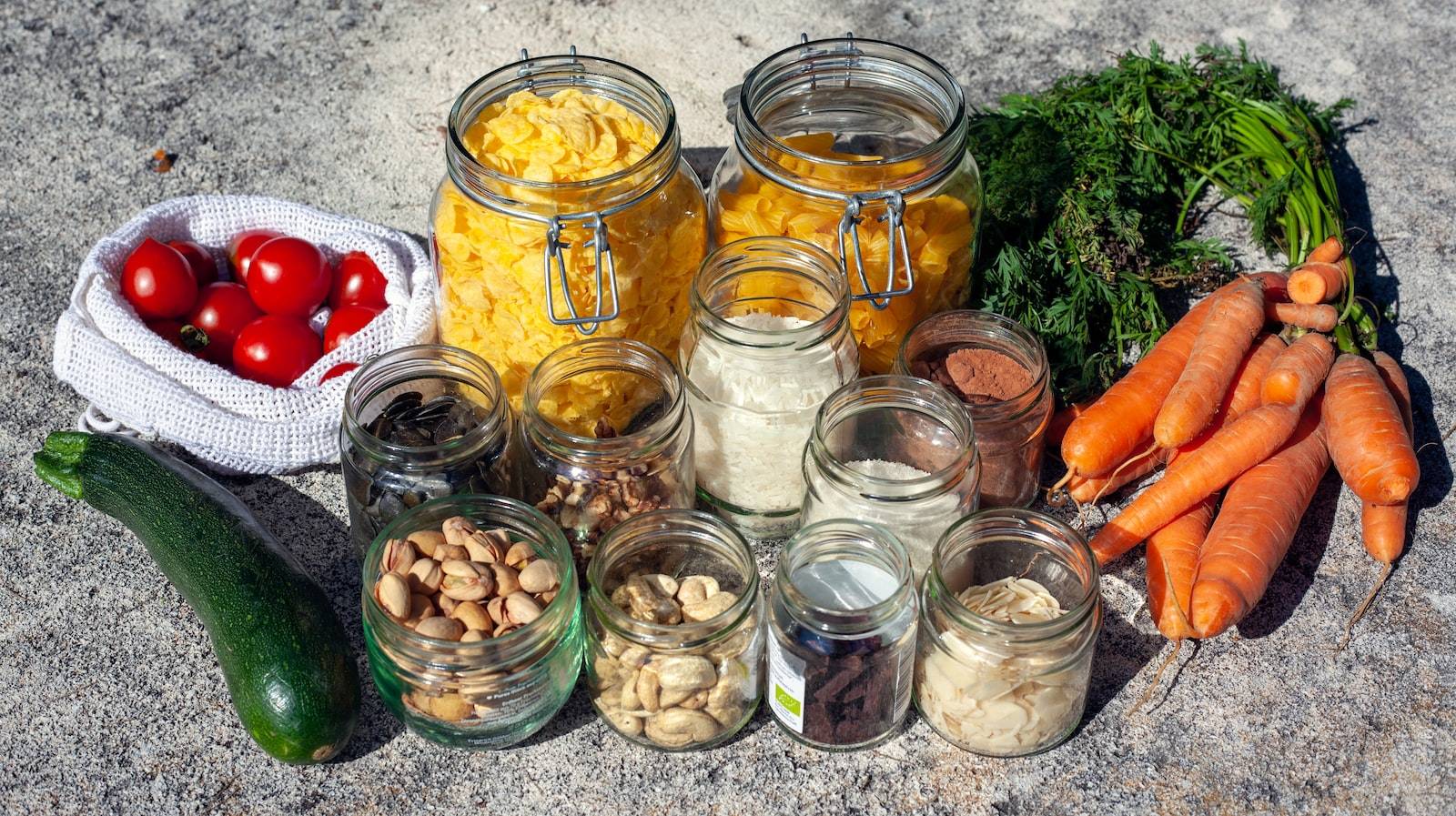
clear glass jars with green leaves

Plastic free shopping

26. Feb 2020

clear glass jars with green leaves
All Articles

Disclaimer

The views expressed here represent the personal perspectives of their authors and do not necessarily reflect the official positions of Youth4Planet.

Plastic is everywhere, in almost every product we have around us. We see plastic in the news and it’s on everyone’s lips, literally, because even in food the plastic is there. But it shouldn’t be that way, and in fact, many people are trying to reduce their plastic consumption, because plastic is highly harmful to the environment. But what is plastic anyway and how does it work to do without this ubiquitous substance? You will find some answers in this text.

The Problem with Plastic: Why It’s Time to Rethink Our Relationship with Synthetic Material

So, some basic information to start with. Plastic is another word for synthetic material and was invented in 1839 by Charles Goodyear. The good thing about this material is that it is suitable for many things, because it is light, does not break and is very durable.
But it takes a lot of petroleum to make it, a substance that is in limited supply. In addition, a lot of toxins are produced during the manufacturing process. Probably the biggest problem, however, is that plastic is not biodegradable. And so all plastic that ends up somewhere stays there, or at least takes a very, very long time to degrade. A standard PET bottle, for example, takes about 450 years to decompose. And unfortunately, a lot of plastic ends up in the sea and is either eaten by fish, drifts around or forms waste whirlpools together with a lot of other waste.

That’s why it’s very important to reduce your own plastic consumption, for the sake of the environment, and also for the climate, because when plastic is burned, a lot of CO² and a lot of other climate-damaging substances are blown into the air, which massively drives climate change.
So far so bad. But how can we reduce plastic in everyday life? After all, plastic is in almost everything.

In this paragraph you will find a few tips on the subject of ‘unpacked shopping’.

Shopping plastic-free: Tips for reducing packaging waste at the grocery store

Of course, the best places are weekly markets or stores that offer only or at least partially unpackaged goods. There you can take your own containers, cans or jars and fill them up with what you want. Fruits and vegetables can always be bought without packaging anyway, generally they have a peel after all and survive the trip to the home fruit bowl just fine without baggies. And if you want to keep all the tomatoes together, there are reusable vegetable nets, cotton bags or similar alternatives.

Using household items for plastic-free shopping

Pillowcases for the bread, jam jars for the nuts, lunch boxes for olives and cheese. There are things in every household that will allow you to shop plastic-free, you just have to look really hard.

Shopping unpackaged at the supermarket: Tips for finding alternatives

And if there is not (yet) an unpacked store in your area, or if it is too far away for the tempting once-in-a-while shopping? You can also shop unpackaged quite well in the supermarket.
Granted, it requires a willingness to look for alternatives, but that’s the way it is anyway; instead of waiting for your favorite salami to be available without plastic, switch to some from the sausage counter that you can have filled into your own bread box.

Conclusion

Get creative, take different routes than usual. You will see, for almost everything there is either another product in glass or an idea to make it yourself.

So: try it out and gradually switch to unpackaged or differently packaged products.
It’s worth it, for you, the environment and the climate. Because we are responsible for this world, each and every one of us.


1 comment

Leave your comment

Read on

Subscribe to our Newsletter

Newsletter
Back to Field Notes
  • What are we in Luxembourg actually Regenerating? Reading the FT Climate Dashboard thru Tenzin Seldon’s GDR Lens

    As Financial Times Journalists Dan Clark, Steven Bernard, Sam Joiner and Justine Williams write yesterday: “The Financial Times has created a searchable dashboard of 197 countries’ historical emissions and future climate targets, providing information on the energy mix that indicates their progress on renewable energy. The database is in its sixth iteration, after being first…

    Find out more
  • Dear Ambassador Audrey Tang, What does “ownership” of 3 Degrees Celsius of Global Warming mean for Luxembourg?

    Take a few minutes to read Financial Times’ Journalist Ian Johnston’s article (#GiftLink https://giftarticle.ft.com/giftarticle/actions/redeem/44808d1c-c2fc-4513-bd74-02206d6d1343) and reflect: what does “ownership” of 3°Celsius of Global Warming mean for Luxembourg? . . . especially through the lens of Plurality-author by the renowned scholar and Taiwan Ambassador Audrey Tang. Question: How are we pro-actively preparing . . . with…

    Find out more
  • Reimagine Howald

    #ReimagineHowald Nine years of railway-transformation have brought Howald a major mobility hub. The Big Question: what kind of everyday place will this hub will pollinate? CFL – Société Nationale des Chemins de Fer Luxembourgeois’ Howald Railway-station now connects trains + trams + buses + people who park cars + people who pedal bicycles + people…

    Find out more
  • A small “Pay it forward” MERCI Villmols to Differdange

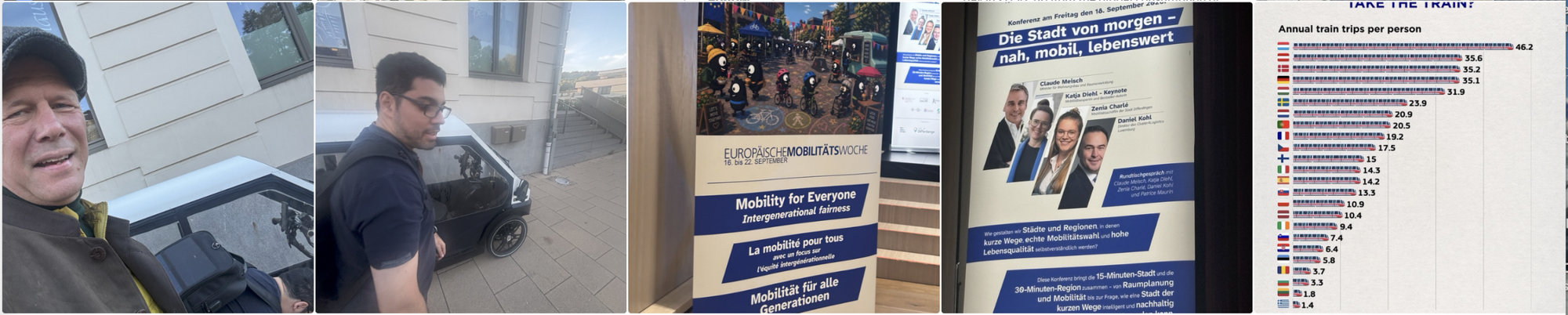
    Last week’s EU Mobility Week gathering in Differdange gave us something valuable: an inspiring round-table discussion by Housing Minister Claude Meisch + Expert Katja Diehl + Mobility Manager for the City of Differdange Zenia Charlé + Director of Cluster4Logistics Luxembourg Daniel Kohl + LuxMobility Managing Director Patrick van Egmond = people who care deeply about…

    Find out more
  • We do not lack courage, intelligence or capital

    We do not lack courage, intelligence or capital. We lack more useful mountains to climb. When I was much, much younger . . . I looked forward to Jeremy Clarkson’s columns in The Sunday Times. Jeremy then and now writes with panache, taking an engineering problem, a political absurdity or an ill-advised adventure and making…

    Find out more
  • #GoGoVelo Day 4: what no KPI can measure

    Day 4 began at 6:29 this morning as I pedaled down Ville de Luxembourg’s avenue Franklin D. Roosevelt . . . followed rue Ulric into the Grund and climbed the cobblestones of the Montée du Grund towards the Ville Haute. I passed the Lëtzebuerg City Museum and the very old Église Saint-Michel before turning towards…

    Find out more
  • Today is Day 2 of Provelo.lu + Klima-Bündnis + 🇱🇺Ministry of Mobility & Public Works’ Autumn 2026 GoGoVelo autumn campaign

    Yesterday, I participated in the GoGoVelo campaign while pedaling a bicycle in London. London keeps showing what happens when #ActiveMobility moves from niche to normal. Rental e-bikes seem to outnumber cars . . . and are everywhere. Cargo bikes, foldable Brompton Bicycles, commuters + visitors mix into everyday streets. Isaac Newton’s legacy shares space with…

    Find out more
  • 28.08-20.09, Mosel & Saar: CreatiVelo Earthbeat Tour

    Pressemitteilung Vom 28. August bis 20. September 2026 bringt die „CreatiVelo Earthbeat Tour“ Jugendliche aus Luxemburg, Rheinland-Pfalz und dem Saarland zusammen und gibt ihren Ideen und Zukunftsvisionen eine Stimme. Möglich wird die Tour durch das grenzüberschreitende LEADER-Projekt „Austausch über Grenzen“. Die drei LEADER-Regionen Miselerland, Moselfranken und Merzig-Wadern arbeiten darin gemeinsam daran, die deutsch-luxemburgische Nachbarschaftsregion als…

    Find out more
  • BNE 2026, ChangeNOW and Climate Action Tiger’s Take-aways for the period 16th April 2026 – 24th March 2026

    What becomes visible this spring, as one looks carefully enough, is not merely a sequence of events . . . but a sequence of scales: at the BNE Days 2026 in Luxembourg, the scale was national, pedagogical, almost deceptively modest. Yet the architecture was unusually ambitious. Three pillars . . . networking, training, youth. A…

    Find out more
  • Yes or No question: Safety is something that must be argued for?

    Should “safety” be something that must be argued for . . . or should “safety” be simply there? There are moments when a country is asked a difficult question . . . and this time, the question has been formalized. Public Petition n°3984 https://www.petitiounen.lu/fr/petition/3984 is collecting signatures on the Chamber of Deputies Luxembourg website. Public…

    Find out more