
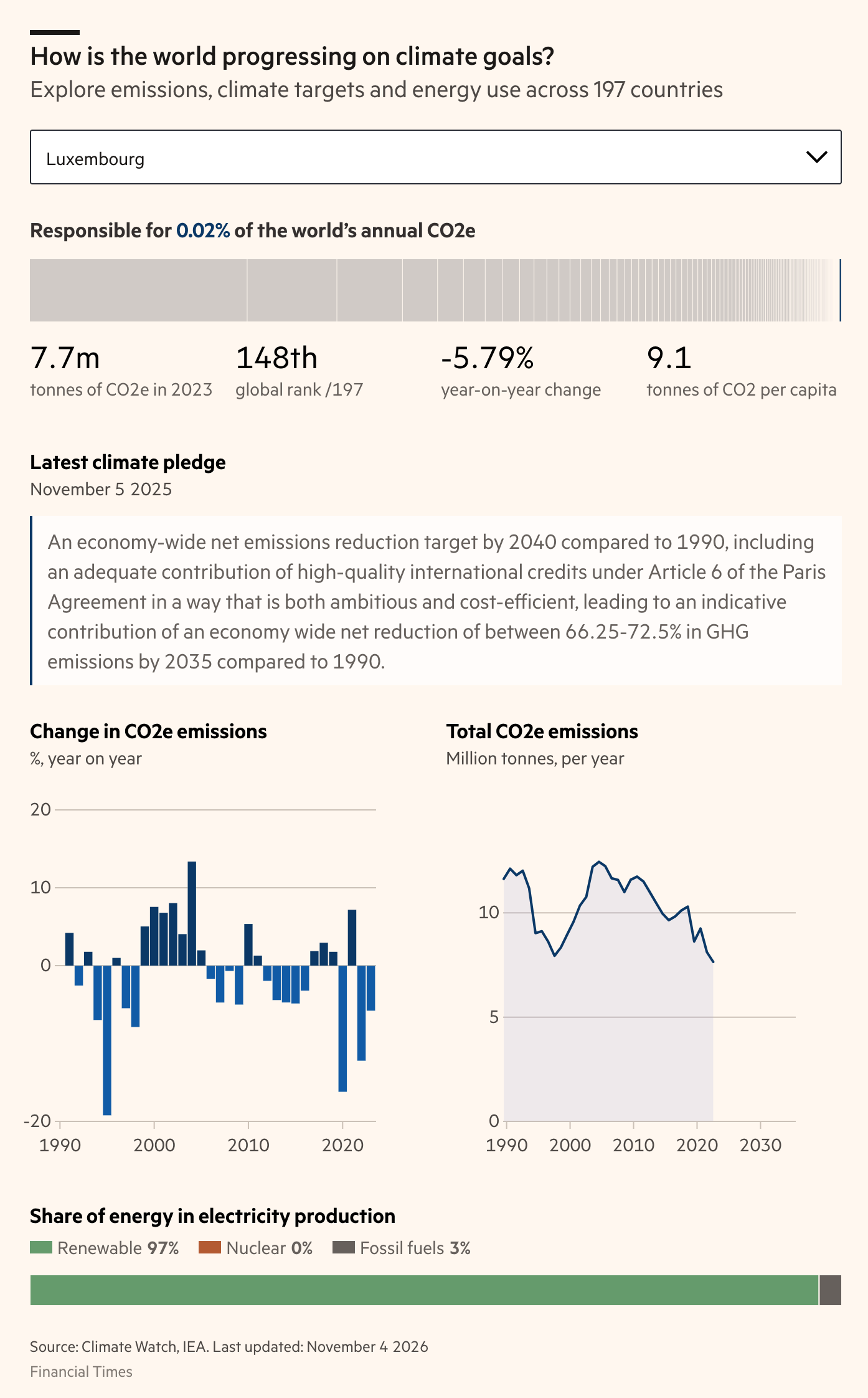
As Financial Times Journalists Dan Clark, Steven Bernard, Sam Joiner and Justine Williams write yesterday: “The Financial Times has created a searchable dashboard of 197 countries’ historical emissions and future climate targets, providing information on the energy mix that indicates their progress on renewable energy. The database is in its sixth iteration, after being first published at the time of the UN COP26 climate summit in Glasgow in 2021. It uses data from Climate Watch and the International Energy Agency. The top five emitters appear at the top of the drop-down — but searching any country name will yield its data.” Here is the link to their article https://www.ft.com/content/9dfb0201-ef77-4c05-93cd-1e277c7017cf?shareType=nongift and here is a snapshot of Luxembourg’s profile:
Question:
- What would a Gross Domestic Regeneration Scorecard say about Luxembourg?
A few reflections:
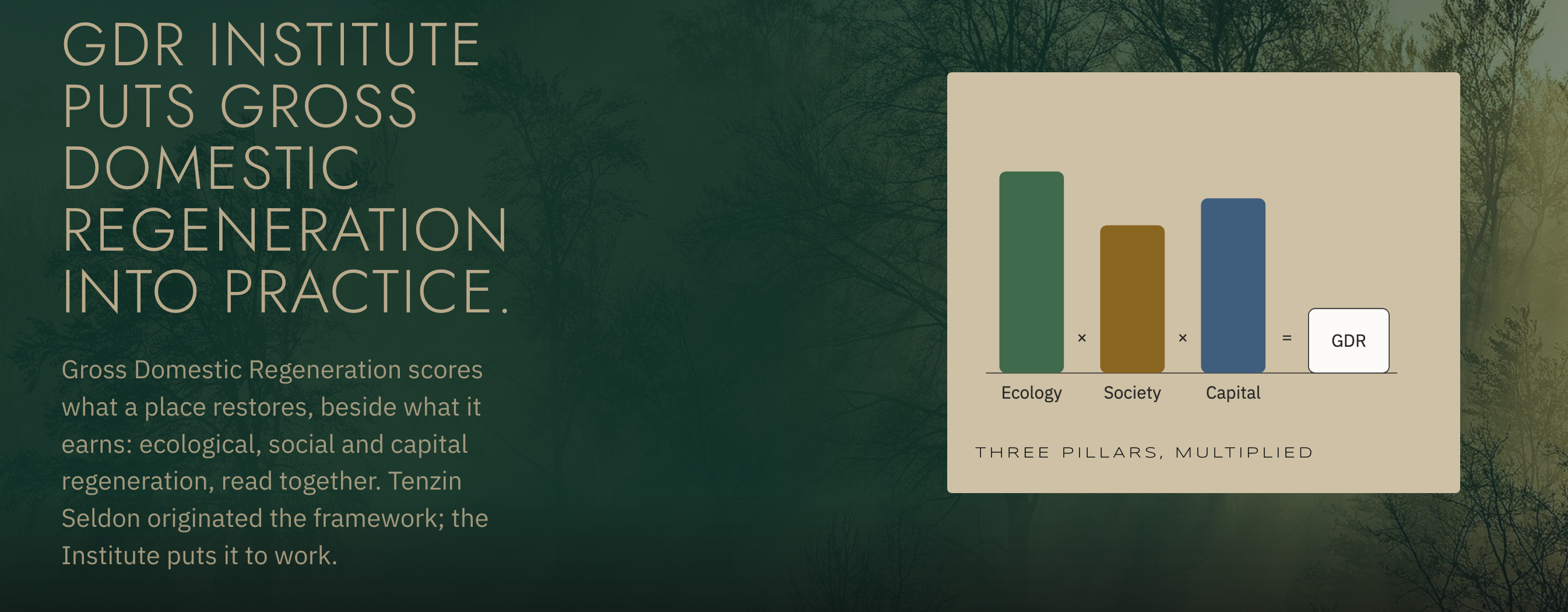
A Gross Domestic Regeneration (GDR) scorecard would give Luxembourg a sharply split verdict: strong on some social protections, but failing badly on the ecological pillar . . . and because GDR multiplies its three scores rather than averaging them, that ecological weakness would drag the overall result down substantially. Why? Tenzin Seldon’s GDR framework scores an economy on three interconnected dimensions:
- Ecological Regeneration: are water, soil, forests, and natural systems getting stronger or weaker?
- Social Regeneration: are communities healthier and more resilient?
- Capital Regeneration: is investment compounding value or extracting it?
Crucially, the three scores are multiplied, not averaged . . . so “a strong balance sheet can’t offset an exhausted watershed”. The GDR Institute is developing indicators including emissions intensity, protected land, poverty, healthcare coverage, wealth distribution, export concentration, and public debt.
Read Tenzin Seldon’s linkedin post: https://www.linkedin.com/posts/the-metric-problem-why-smart-capital-is-share-7477384696046419968-vjDf/
Read Jessica Ratushniak’s op-ed essay from Canada: https://viewpointfoundation.ca/what-is-gross-domestics-regeneration/
Read Tenzin Seldon’s Pulse Fund essay: https://www.pulsefund.com/overview/gross-domestic-regeneration
Now . . . let’s explore Luxembourg’s performance against GDR’s three pillars:
The Ecological Pillar: a clear Failure. This is where Luxembourg’s scorecard would collapse. The FT dashboard’s 97% renewable electricity figure measures only domestic production, but GDR asks whether the economy is regenerating what it depends on. The evidence says no:
- Consumption-based emissions are far higher than territorial ones. Luxembourg’s consumption-based carbon footprint was 18.5 tonnes CO₂e per capita per year in 2020 = the emissions generated worldwide to produce what Luxembourg residents consume. Our National Climate Observatory correctly notes that “our consumption generates more greenhouse gas emissions than our production in Luxembourg”.
- Ecological footprint vastly exceeds biocapacity. Older and directionally relevant data showed Luxembourg residents’ ecological footprint at 9.6 global hectares, meaning that if everyone consumed like Luxembourgers, more than 8 planets would be needed.
- Our land-use is extractive, not regenerative: urban sprawl consumed 1,390 hectares between 1999 and 2006, with single-family homes using land extensively (675 m² per home built between 2004–2007), driving car dependency and fragmenting landscapes.
- Under GDR’s multiplicative logic, a weak ecological score cannot be rescued by strengths elsewhere.
The Social Pillar: Mixed, with Serious Caveats. Luxembourg’s social indicators present a more complicated picture = some genuine strengths, but persistent inequalities that a GDR scorecard would flag:
- Poverty persists despite wealth. The monetary poverty rate stands at 14.8% in 2025, affecting roughly one in seven residents. Young people are disproportionately affected: 22.2% of under-18s are at risk of poverty = nearly 30,000 young people.
- Inequality is marked. The richest 20% have a standard of living 4.6 times higher than the poorest 20%, with a Gini-coefficient of 30.5%. Read STATEC’s PDF report https://statistiques.public.lu/dam-assets/actualite/2026/stn14-silc-2025/stn14-26-silc-2025-en.pdf#1#1#1
- Social transfers do heavy lifting. Without social assistance, the poverty rate would be 26.5% rather than 14.8% = meaning the system prevents poverty for many, but underlying market inequality remains substantial.
- Single-parent families and tenants are especially vulnerable. 40.5% of single-parent families are at risk of poverty, as are 23.7% of tenants.
- Luxembourg’s safety net demonstrably works, and we need to improve.
The Capital Pillar: Ambiguous. The search results offer less direct evidence on capital regeneration. However, one relevant signal:
- Luxembourg’s private R&D investment has been declining, with business R&D expenditure falling to 0.48% of GDP (€380 million, down from €400 million in 2023), and the country ranking 20th out of 27 in the EU for R&D intensity.
- If GDR’s capital pillar asks whether investment is “compounding value or extracting it,” declining productive investment alongside a dominant financial sector would raise questions about whether Luxembourg’s capital is building long-term resilience or simply optimizing for financial returns.
- Read IDEA Luxembourg’s 132-page PDF annual report: https://www.fondation-idea.lu/wp-content/uploads/sites/2/2025/04/IDEA_AVIS_ANNUEL_2025.pdf#10#26#10
The GDR Verdict on Luxembourg. Luxembourg’s GDR scorecard would say something like this:
- Ecological regeneration: FAIL. Consumption-based emissions are high, ecological footprint exceeds carrying capacity, and land use patterns are extractive. The 97% renewable electricity figure is an accounting artifact of a small, import-dependent system, not evidence of regeneration.
- Social regeneration: PARTIAL PASS. Strong social transfers prevent deeper poverty, but inequality and youth poverty remain significant.
- Capital regeneration: UNCLEAR/QUESTIONABLE. Declining R&D investment and reliance on a financial sector that may extract rather than compound value raise doubts.
Because GDR multiplies rather than averages, the Ecological Failure would dominate the final score. Luxembourg might look good on a dashboard that measures domestic electricity production, but a GDR scorecard would expose that the country is consuming more than it regenerates . . . which is precisely the gap Seldon’s framework was designed to reveal.
Visit the GDR Institute: https://gdrinstitute.org/about