Opens in a new tab

Argentina’s Real Return . . . from Borrowed Dollars to Abundance Engines

16. Dec 2025

All Articles

Disclaimer

The views expressed here represent the personal perspectives of their authors and do not necessarily reflect the official positions of Youth4Planet.

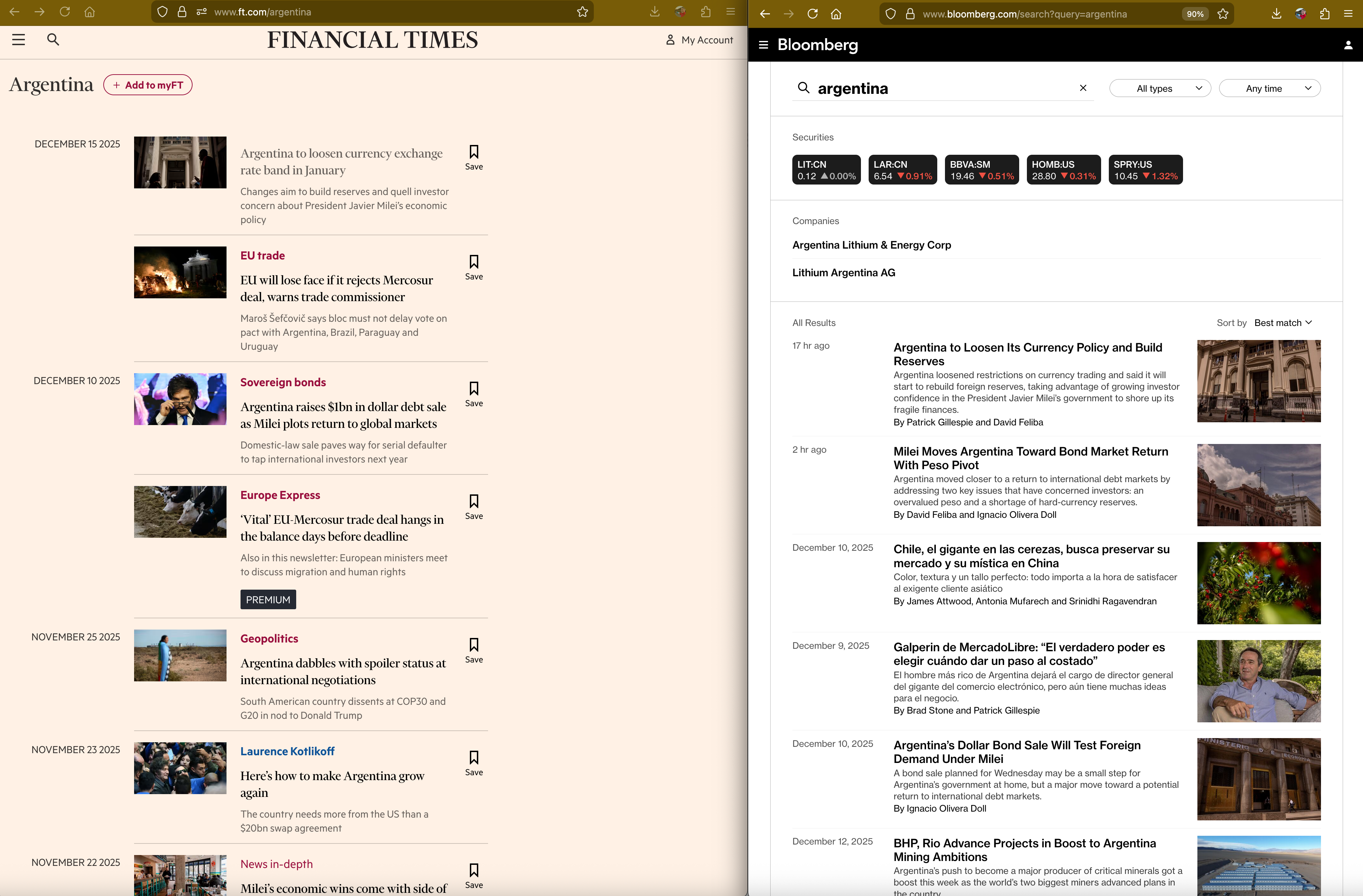
As the Financial Times and Bloomberg report on Argentina’s push to recalibrate its currency regime, rebuild reserves, and test demand for dollar debt . . . a more fundamental ledger is often treated as secondary: the difference between an economy that must constantly source external dollars to keep the system running, and one that systematically reduces its need for them.

The government’s near-term focus is the External Dollar Ledger: exchange-rate management, reserve accumulation, market access, and credibility. Financial Times and Bloomberg reporting on the move to widen the peso band in line with inflation captures that logic precisely: stabilise expectations; rebuild buffers; avoid the next run.
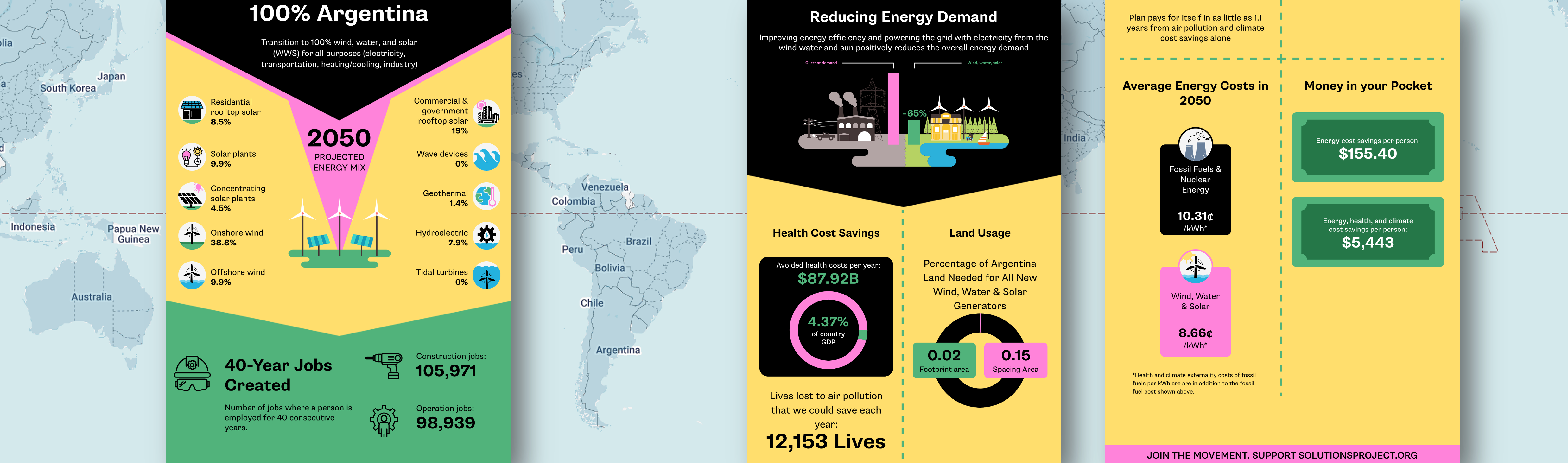
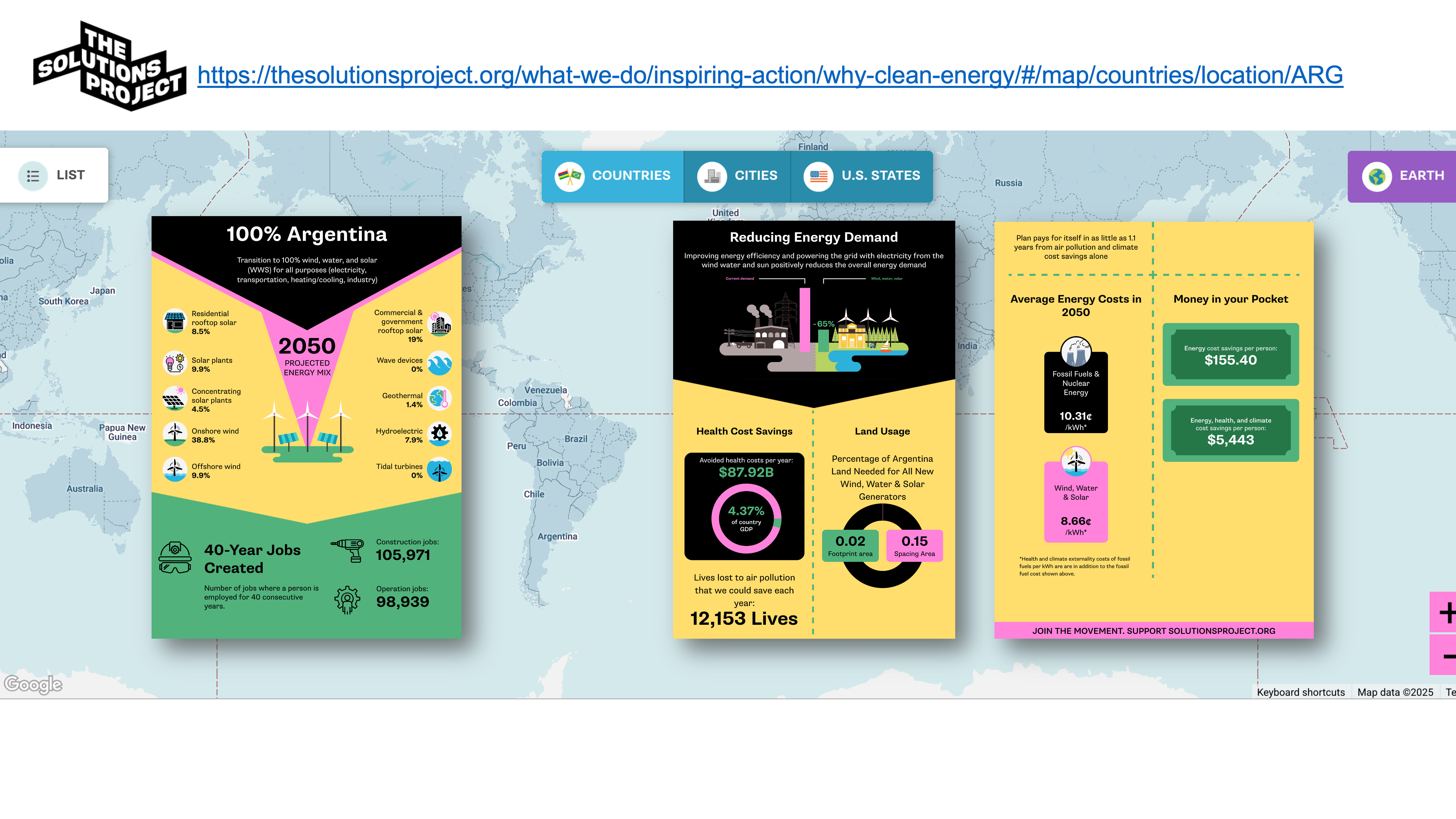
A parallel ledger exists: the Internal Value Ledger. The Solutions Project’s 100% wind, water and solar pathway for Argentina (2050) translates energy sovereignty into recurring national value: avoided health costs, lives saved, lower system energy costs, and long-term employment . . . https://thesolutionsproject.org/what-we-do/inspiring-action/why-clean-energy/#/map/countries/location/ARG
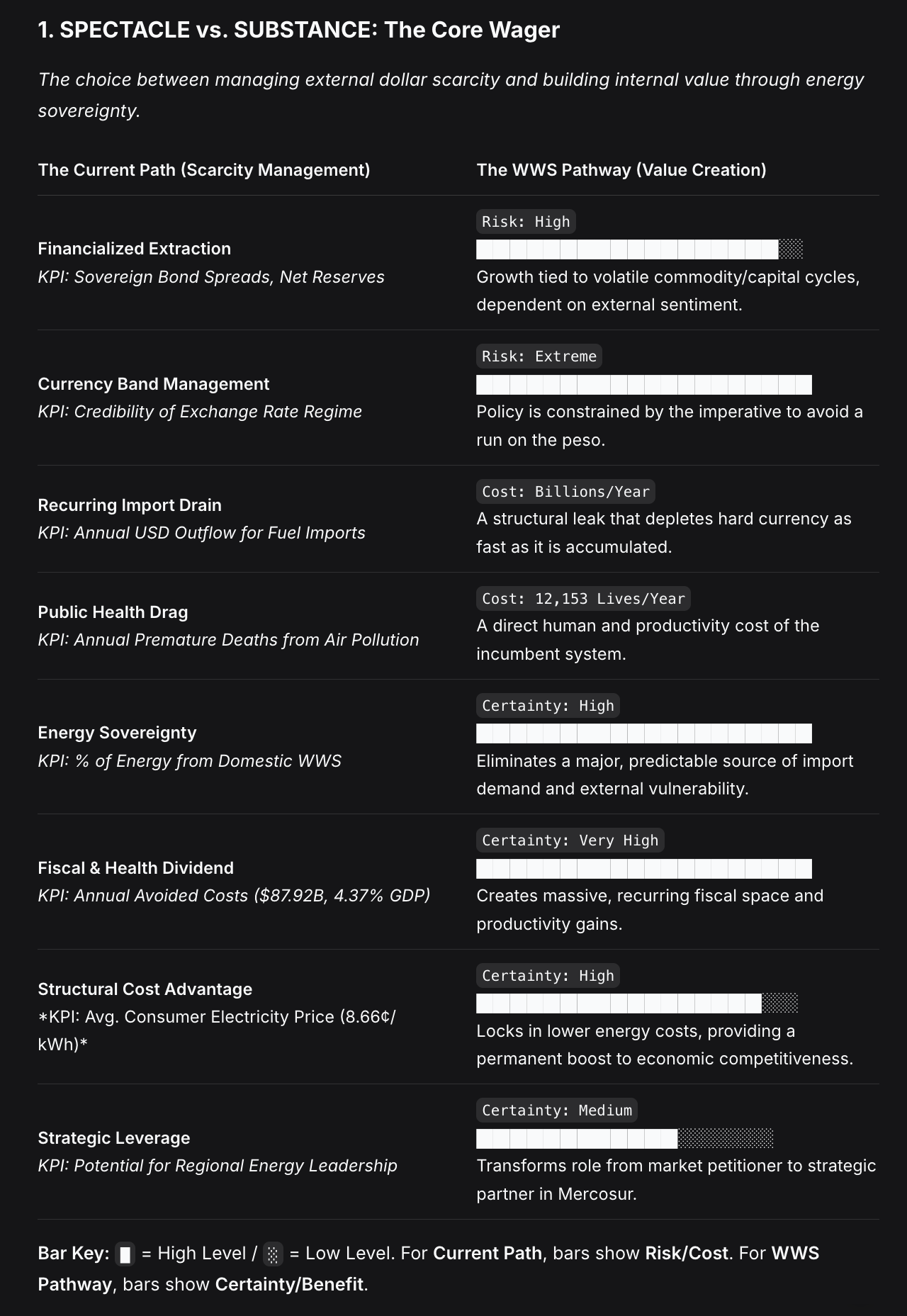
Two economic models . . . two kinds of “return”:

(A) The current path: scarcity management through financialisation and extraction:

‣ Primary indicators: net reserves, spreads, bond deals, the credibility of the currency band.
‣ Growth channel: volatile commodity and capital cycles; policy constrained by external creditors and investor sentiment.
‣ Structural risk: the country accumulates dollars through bond sales and export taxes, only to bleed them back out through recurring fuel imports and crisis dynamics.

(B) The alternative path: value creation through energy sovereignty:
‣ Primary indicator: the scale and speed of import exposure reduction, plus public health and productivity gains.
‣ Growth channel: domestic asset-building that retains more value locally and stabilises the cost base of the economy.

What The Solutions Project reports for Argentina:
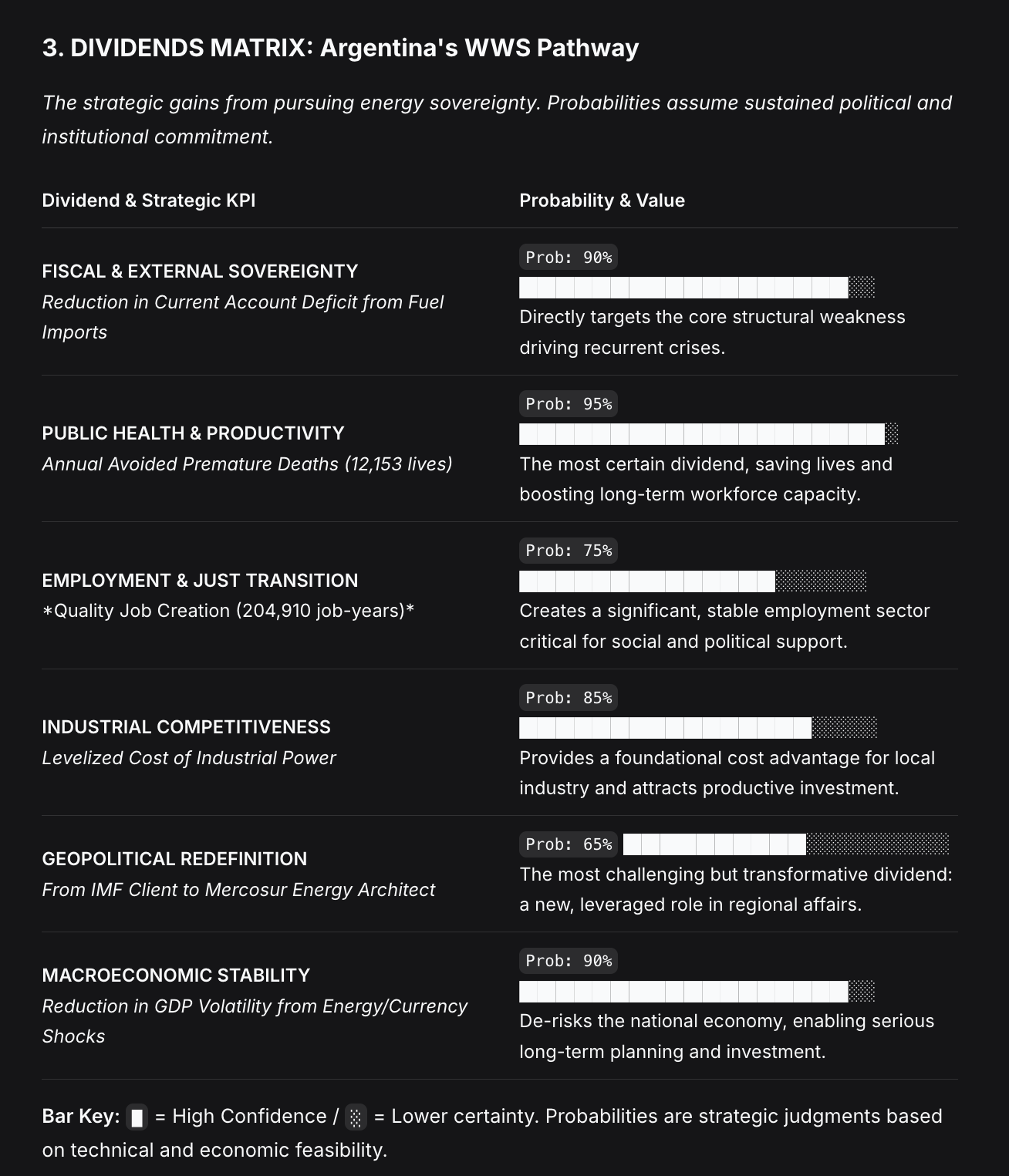
‣ Avoided health costs: $87.92B per year (4.37% of GDP); lives saved annually from air pollution: 12,153.
‣ Jobs (expressed as “40-year jobs”): 204,910 total (105,971 construction; 98,939 operations).
‣ Average energy costs in 2050: 8.66¢/kWh for wind, water and solar versus 10.31¢/kWh for fossil fuels and nuclear.
‣ Combined energy, health, and climate savings per person: $5,443 per year.
The investor case: turning sovereign risk into sovereign strength: Financial Times and Bloomberg’s headlines emphasise a government working to convince markets it can service its obligations through currency-regime adjustments and renewed bond activity.

The WWS pathway is best read as a strategy to reduce the structural drivers of sovereign risk: exposure to imported energy costs, the fragility of the external account, and the public health drag on productivity. A structural reduction in hard-currency demand over time improves debt service capacity more durably than any short-term reserve injection.

A crucial caveat: savings are not instantly liquid: “Dollars saved” on future fuel imports and healthcare are not instantly “dollars available” in the central bank vault. The transition requires upfront investment and faces execution risks. Its macro promise becomes bankable when policy design turns long-term savings into near-term resilience through credible institutions and sequencing.
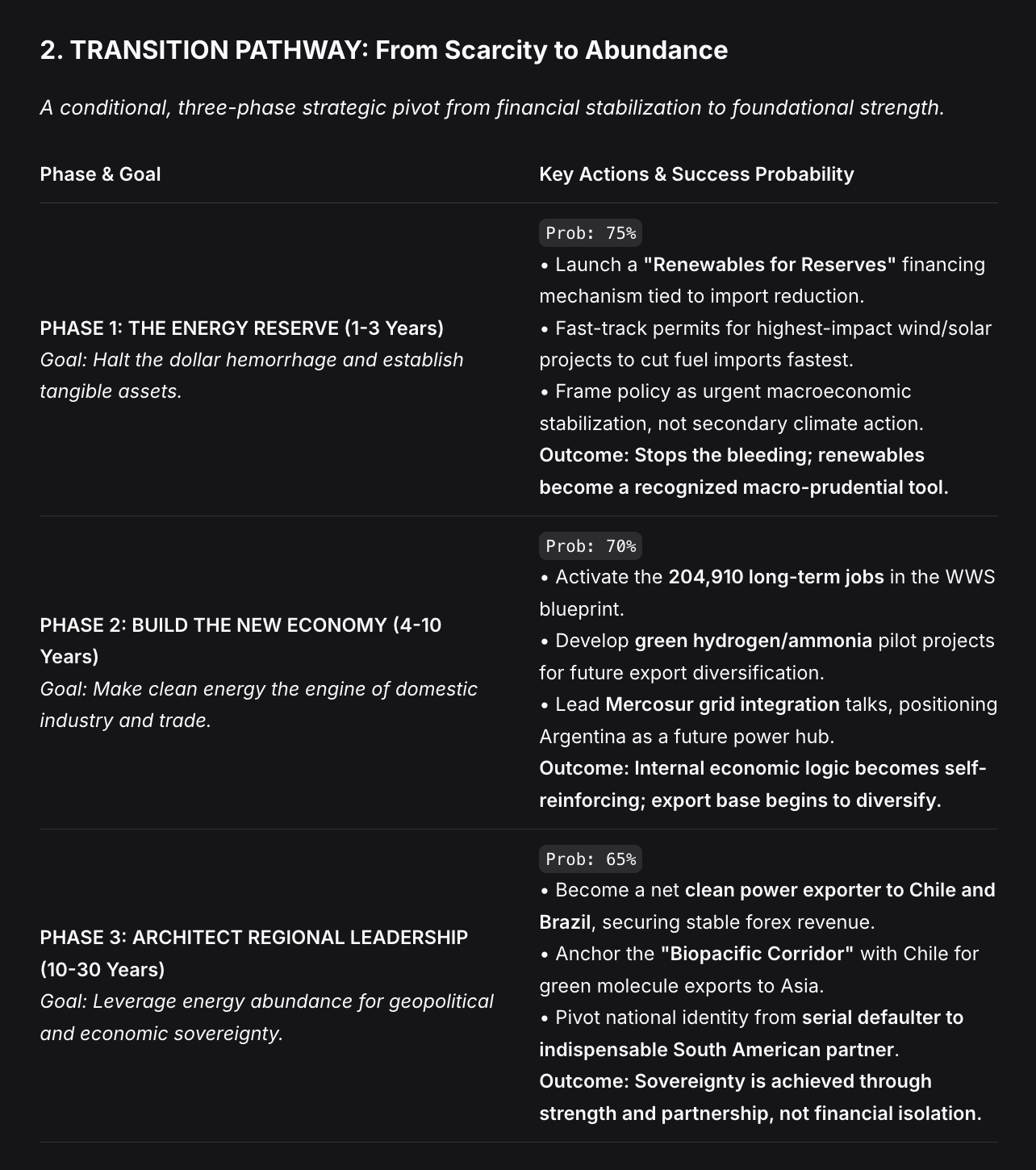
Practical pathways:

‣ Reframe reserves: Build “energy security reserves” measured in installed capacity and import exposure reduced; align public and private financing with that macro target.

‣ Target early wins: Fast-track the highest-impact wind and solar projects that cut import demand fastest, stabilising the economy’s cost base.

‣ Build regional leverage: Treat clean electricity as the basis for industrial competitiveness and, eventually, as the foundation for leadership within integrated South American grids.

Markets are currently being asked to price Argentina’s ability to manage scarcity. A more durable story asks investors to finance Argentina’s capacity to engineer abundance . . . and to make that abundance credible through institutions, sequencing, and rules.
Questions? Ask C.A.T. (“Climate Action Tiger”) and Christian: christian@youth4planet.org

Leave the first comment

Read on

Subscribe to our Newsletter

Newsletter
Back to Field Notes
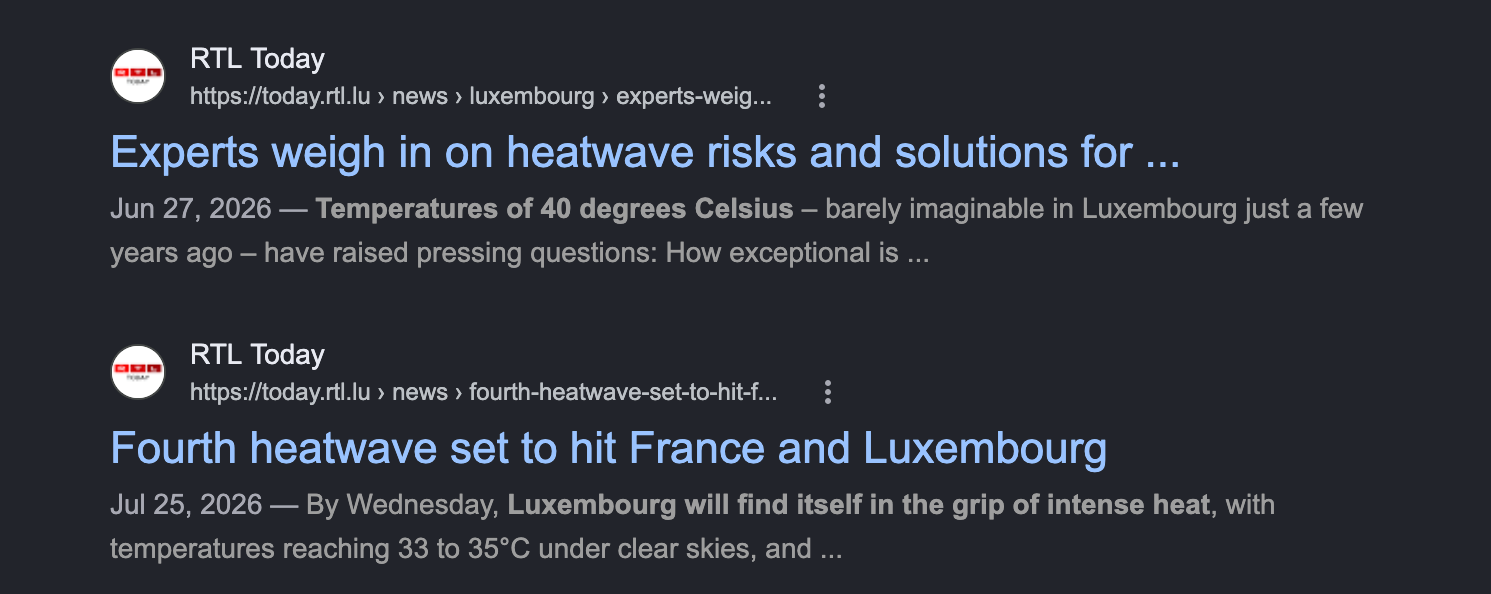
  • What are we in Luxembourg actually Regenerating? Reading the FT Climate Dashboard thru Tenzin Seldon’s GDR Lens

    As Financial Times Journalists Dan Clark, Steven Bernard, Sam Joiner and Justine Williams write yesterday: “The Financial Times has created a searchable dashboard of 197 countries’ historical emissions and future climate targets, providing information on the energy mix that indicates their progress on renewable energy. The database is in its sixth iteration, after being first…

    Find out more
  • Dear Ambassador Audrey Tang, What does “ownership” of 3 Degrees Celsius of Global Warming mean for Luxembourg?

    Take a few minutes to read Financial Times’ Journalist Ian Johnston’s article (#GiftLink https://giftarticle.ft.com/giftarticle/actions/redeem/44808d1c-c2fc-4513-bd74-02206d6d1343) and reflect: what does “ownership” of 3°Celsius of Global Warming mean for Luxembourg? . . . especially through the lens of Plurality-author by the renowned scholar and Taiwan Ambassador Audrey Tang. Question: How are we pro-actively preparing . . . with…

    Find out more
  • Reimagine Howald

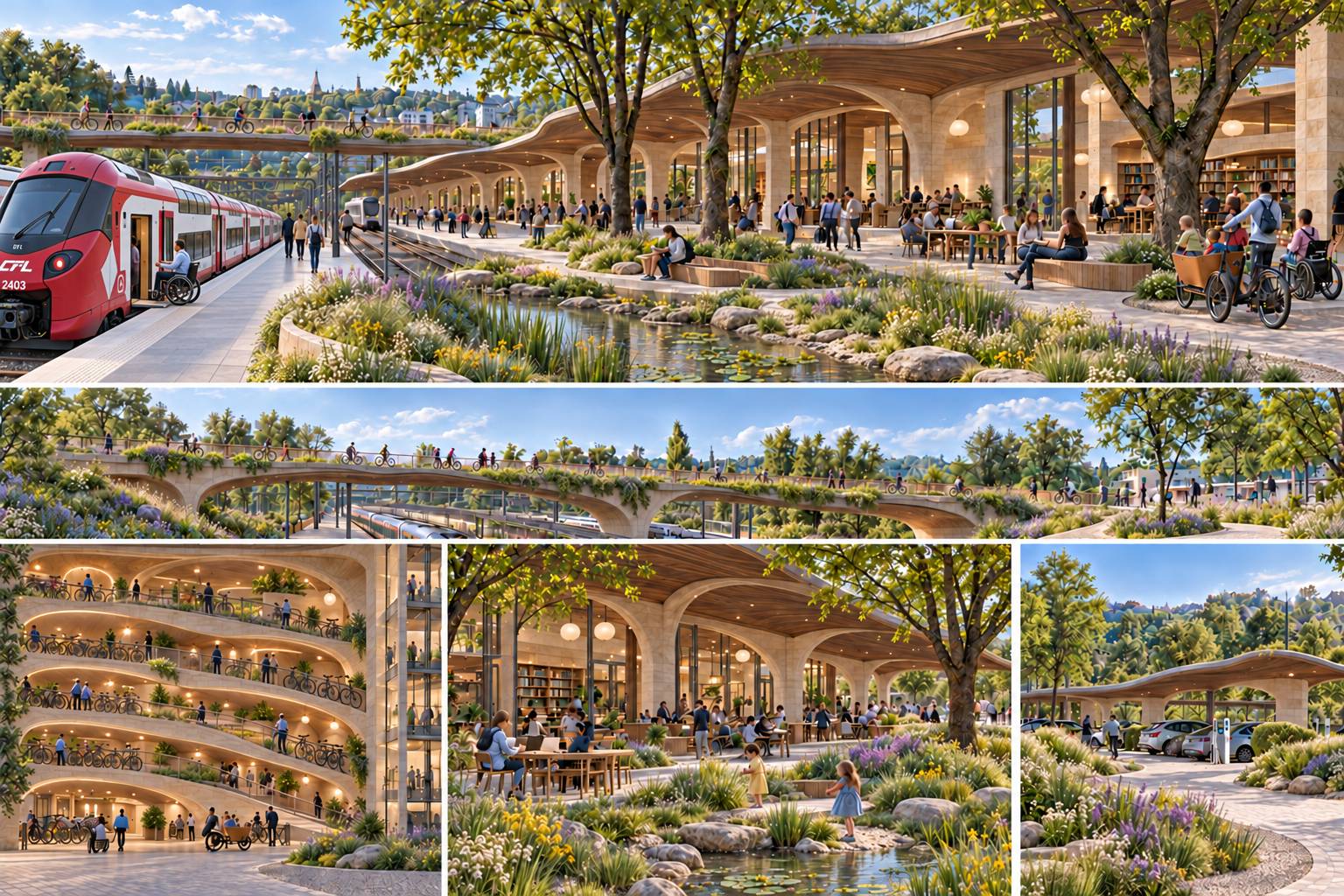
    #ReimagineHowald Nine years of railway-transformation have brought Howald a major mobility hub. The Big Question: what kind of everyday place will this hub will pollinate? CFL – Société Nationale des Chemins de Fer Luxembourgeois’ Howald Railway-station now connects trains + trams + buses + people who park cars + people who pedal bicycles + people…

    Find out more
  • A small “Pay it forward” MERCI Villmols to Differdange

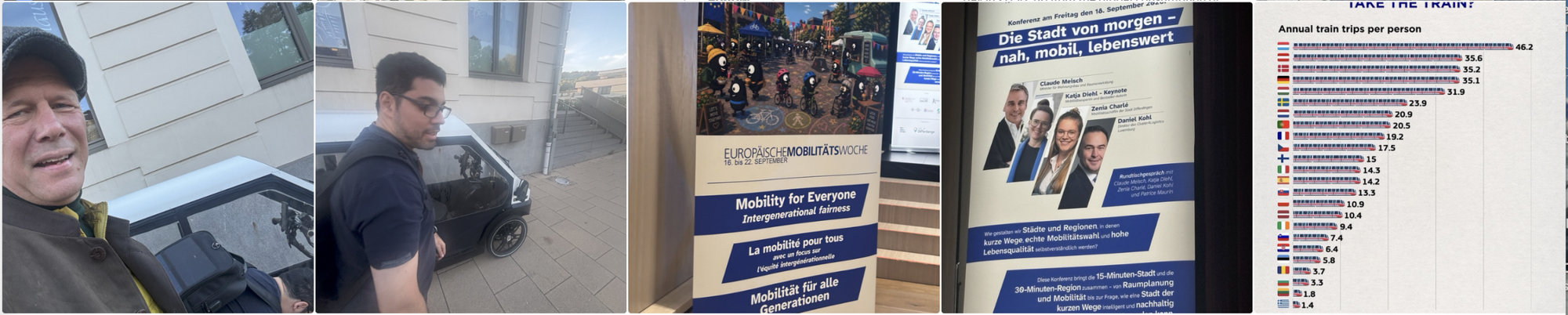
    Last week’s EU Mobility Week gathering in Differdange gave us something valuable: an inspiring round-table discussion by Housing Minister Claude Meisch + Expert Katja Diehl + Mobility Manager for the City of Differdange Zenia Charlé + Director of Cluster4Logistics Luxembourg Daniel Kohl + LuxMobility Managing Director Patrick van Egmond = people who care deeply about…

    Find out more
  • We do not lack courage, intelligence or capital

    We do not lack courage, intelligence or capital. We lack more useful mountains to climb. When I was much, much younger . . . I looked forward to Jeremy Clarkson’s columns in The Sunday Times. Jeremy then and now writes with panache, taking an engineering problem, a political absurdity or an ill-advised adventure and making…

    Find out more
  • #GoGoVelo Day 4: what no KPI can measure

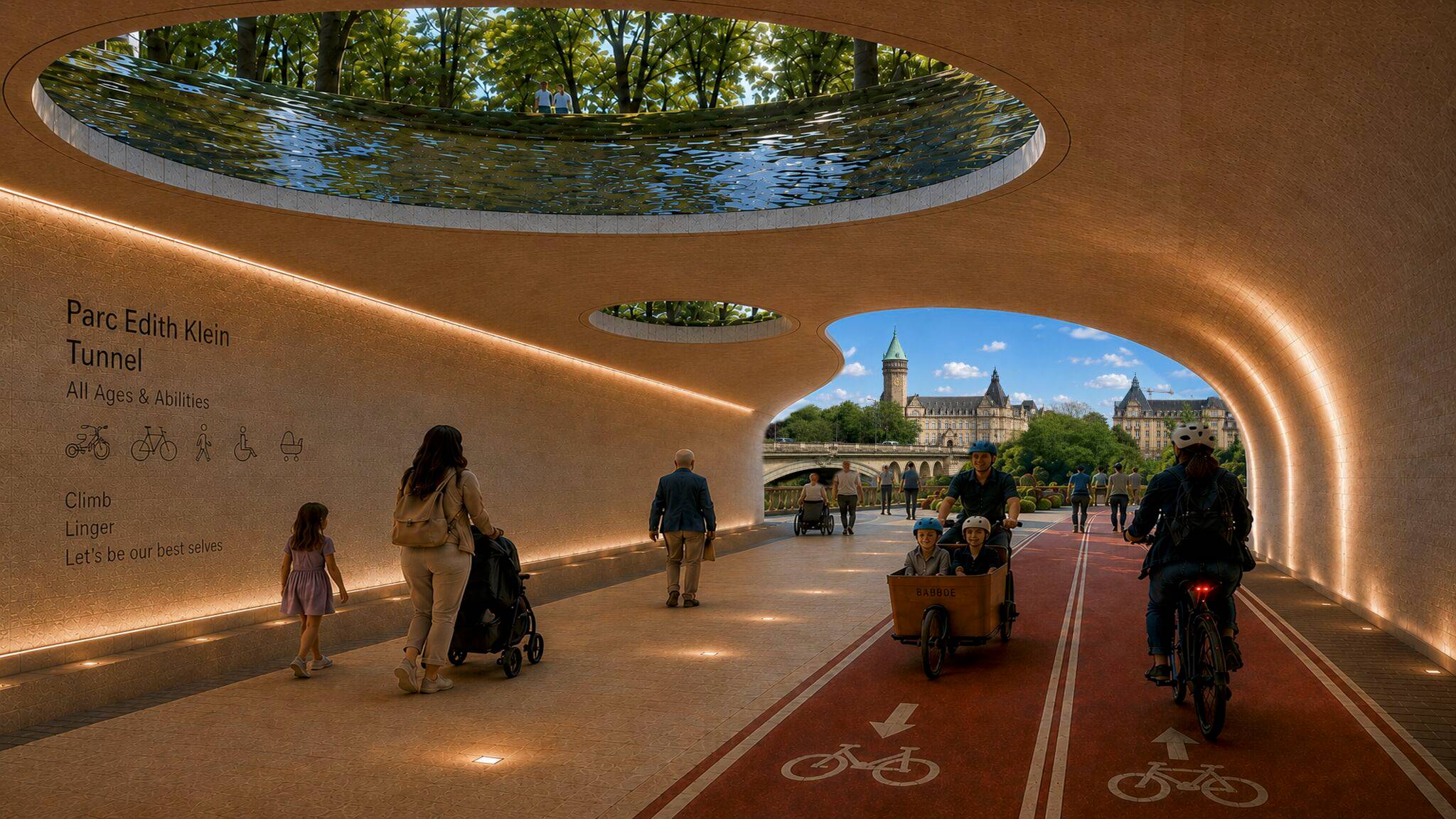
    Day 4 began at 6:29 this morning as I pedaled down Ville de Luxembourg’s avenue Franklin D. Roosevelt . . . followed rue Ulric into the Grund and climbed the cobblestones of the Montée du Grund towards the Ville Haute. I passed the Lëtzebuerg City Museum and the very old Église Saint-Michel before turning towards…

    Find out more
  • Today is Day 2 of Provelo.lu + Klima-Bündnis + 🇱🇺Ministry of Mobility & Public Works’ Autumn 2026 GoGoVelo autumn campaign

    Yesterday, I participated in the GoGoVelo campaign while pedaling a bicycle in London. London keeps showing what happens when #ActiveMobility moves from niche to normal. Rental e-bikes seem to outnumber cars . . . and are everywhere. Cargo bikes, foldable Brompton Bicycles, commuters + visitors mix into everyday streets. Isaac Newton’s legacy shares space with…

    Find out more
  • 28.08-20.09, Mosel & Saar: CreatiVelo Earthbeat Tour

    Pressemitteilung Vom 28. August bis 20. September 2026 bringt die „CreatiVelo Earthbeat Tour“ Jugendliche aus Luxemburg, Rheinland-Pfalz und dem Saarland zusammen und gibt ihren Ideen und Zukunftsvisionen eine Stimme. Möglich wird die Tour durch das grenzüberschreitende LEADER-Projekt „Austausch über Grenzen“. Die drei LEADER-Regionen Miselerland, Moselfranken und Merzig-Wadern arbeiten darin gemeinsam daran, die deutsch-luxemburgische Nachbarschaftsregion als…

    Find out more
  • BNE 2026, ChangeNOW and Climate Action Tiger’s Take-aways for the period 16th April 2026 – 24th March 2026

    What becomes visible this spring, as one looks carefully enough, is not merely a sequence of events . . . but a sequence of scales: at the BNE Days 2026 in Luxembourg, the scale was national, pedagogical, almost deceptively modest. Yet the architecture was unusually ambitious. Three pillars . . . networking, training, youth. A…

    Find out more
  • Yes or No question: Safety is something that must be argued for?

    Should “safety” be something that must be argued for . . . or should “safety” be simply there? There are moments when a country is asked a difficult question . . . and this time, the question has been formalized. Public Petition n°3984 https://www.petitiounen.lu/fr/petition/3984 is collecting signatures on the Chamber of Deputies Luxembourg website. Public…

    Find out more