Pollinate Decency: Streets are infrastructure for human dignity
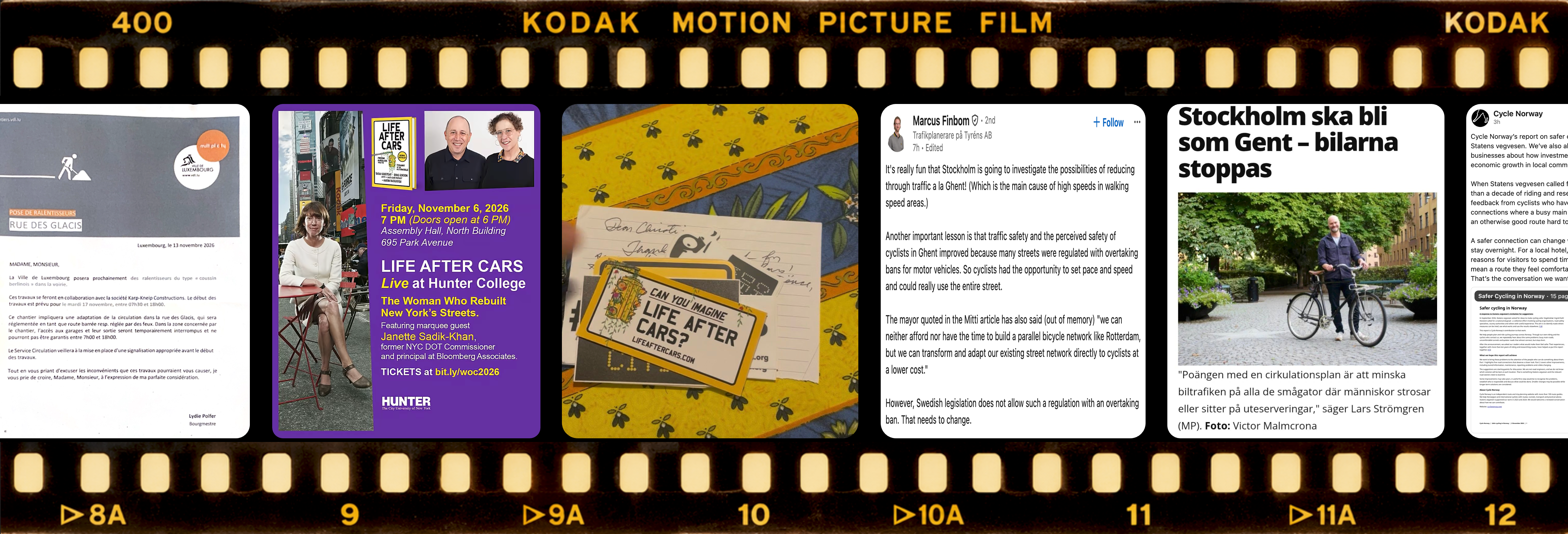
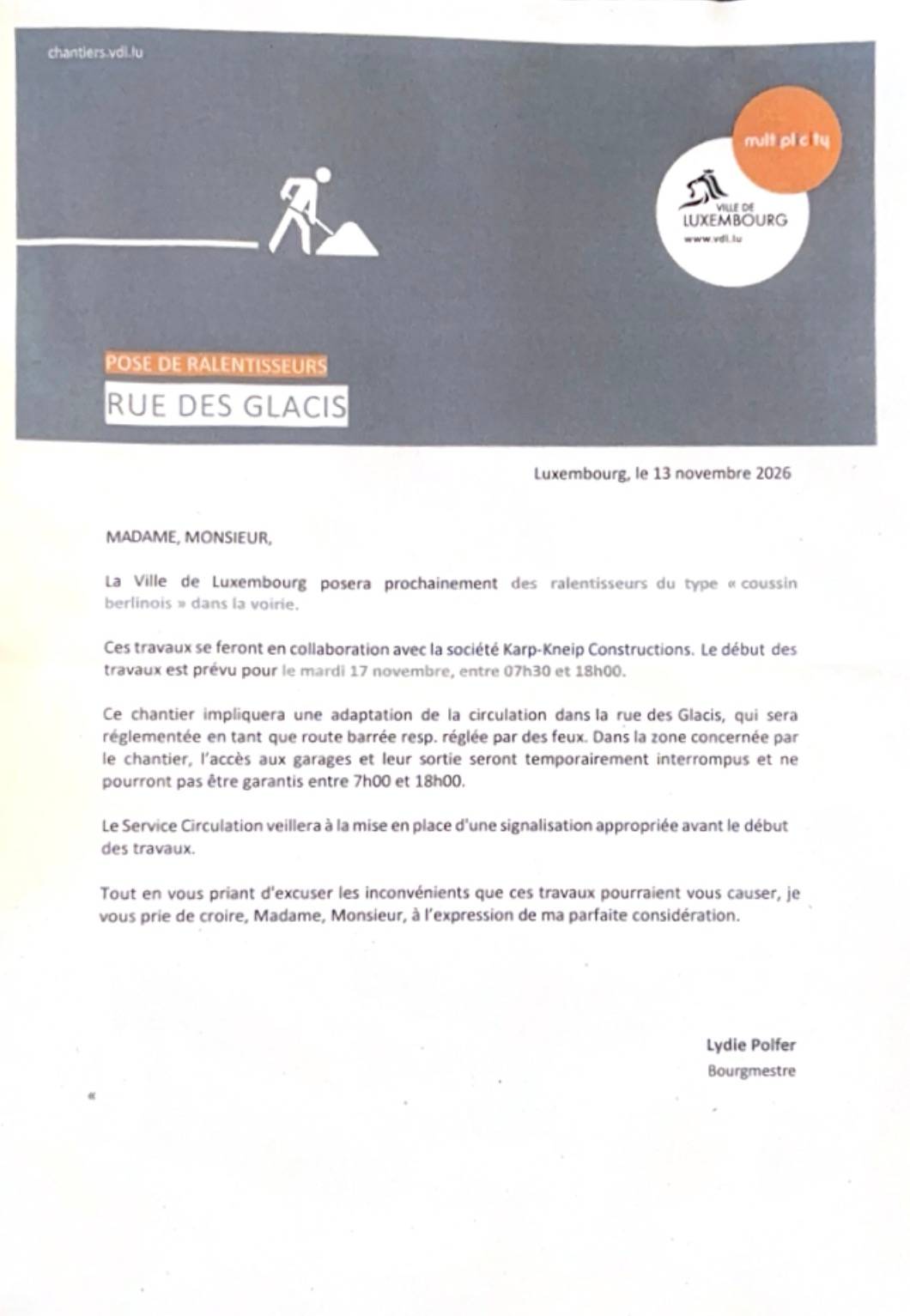
The Universe was kind today. Very very kind. Sarah Goodyear and Doug Gordon sent a note of thanks with their envelope packed full of stickers. News arrived from Stockholm: the city wants to investigate how to make its streets more like Ghent. From Norway came a report asking the national road authority to look seriously at the places where the cycling network fails people. And then, in the post, an announcement from the Ville de Luxembourg: speed bumps are coming to Rue des Glacis. Three messages, arriving from different places, with the same underlying algorithm: our communities require Decency Infrastructure AND intentional Active Mobility incentives.
Sarah and Doug co-host one of the most popular and must-listen to podcasts: The War on Cars. Hopefully, they will publish a transcript and/or video of their recent Hunter College conversation with Janette Sadik-Khan, the former New York City transportation commissioner. That evening mattered because it put practical evidence on the table. A city can change the street and improve daily life without bringing the city to a halt. Commissioner Sadik-Khan’s tenure under Mayor Bloomberg ran from 2007 to 2013. By the end of it, New York had added 365 miles of bike lanes, bringing the city’s network to 573 miles. The city reported that the risk of serious cycling injury had fallen 73% since 2000, while traffic fatalities citywide had fallen 30% since 2001. At locations where major engineering changes had been made, fatalities fell 34% from 2005. These are the city’s reported figures, not proof that one intervention alone caused every improvement. They are still a serious record of what sustained street redesign can achieve.
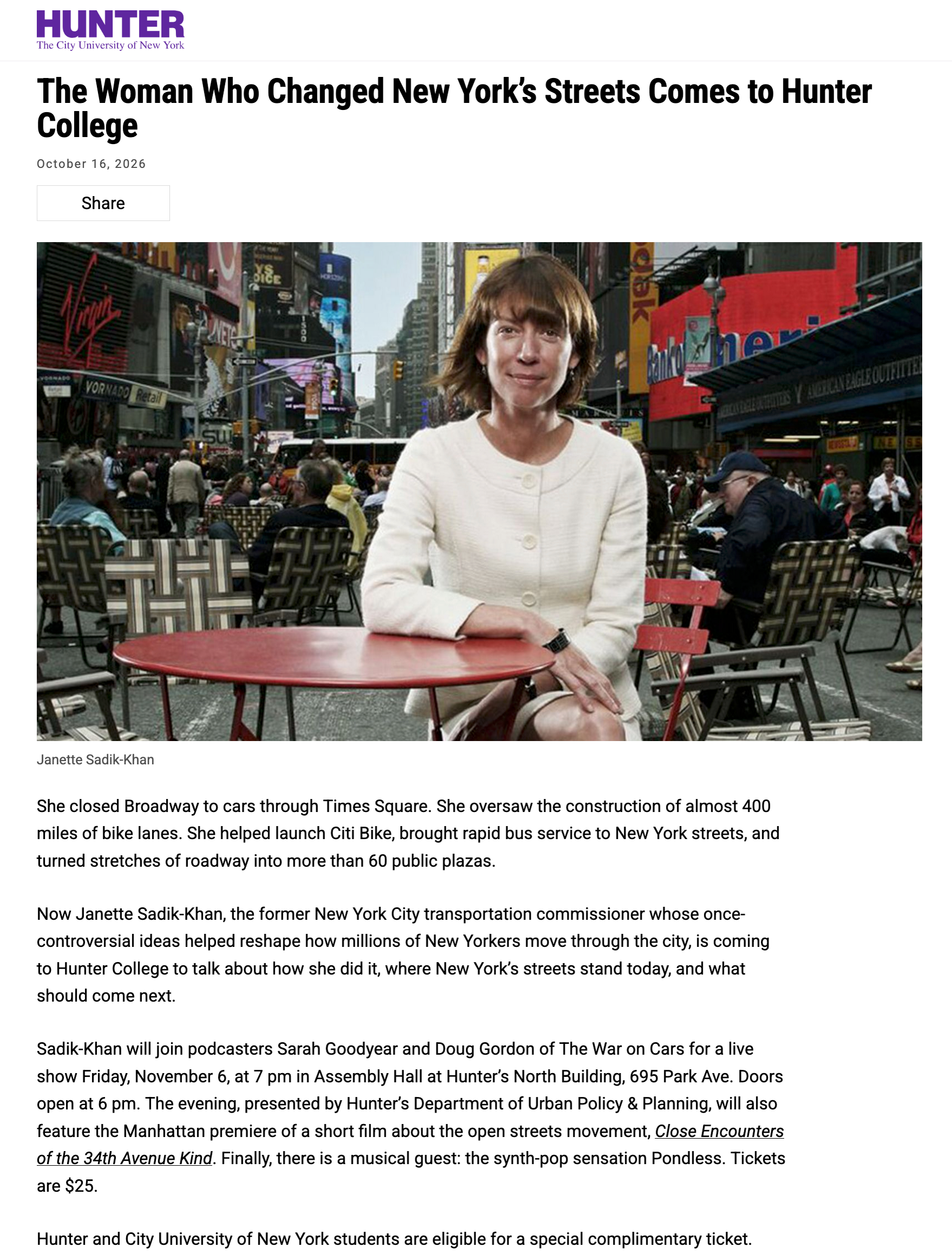
- Times Square is a useful case study in the old false choice between movement and public space. After Broadway was redesigned, pedestrian injuries in the project area fell 35%, injuries to motorists and passengers fell 63%, and taxi speeds in West Midtown rose 7%. A survey found that 76% of New Yorkers supported making the plazas permanent. The point was not to freeze the city. It was to make its busiest streets work better for the people using them.
- Sadik-Khan and her team borrowed ideas rather than pretending New York had to invent everything from scratch. Copenhagen’s protected cycle-lane design influenced New York’s bike network. Paris and London informed the city’s bike-share system. Bogotá’s bus rapid transit helped shape Select Bus Service. Jan Gehl, the Danish architect and urbanist, was part of that Copenhagen encounter. He helped the team look at streets through the eyes of people walking, cycling, sitting and spending time there.
- Gehl’s own intellectual path had many roots. He has described how Jane Jacobs challenged planners who forgot about people, while tracing his own research into public life to social science and his collaboration with his psychologist wife. The important thing is not to award one person sole authorship of an idea. It is to recognise a chain of people observing how cities actually work, learning from one another, and then having the courage to change the street.
Now Stockholm is looking toward Ghent. The proposal is to investigate a circulation plan that would reduce through-traffic while still allowing people to reach every neighbourhood by car. The inspiration is Ghent’s 2017 mobility plan, which reorganised traffic so that driving across the city became harder while walking, cycling, public transport and local access remained possible. The reported results include more people walking and cycling, fewer crashes, faster buses, cleaner air and a lift for local commerce.
- Stockholm has not yet become Ghent. The city’s proposed 2027 budget calls for investigating what a circulation plan could look like. That distinction matters. So does the direction of travel: stop treating every street as a shortcut, and start treating the whole street network as a place where people live.
- The most relevant PDF pages are 10–11 and 151–160. What they cover:
Pages 10–11 = Citywide ambition: Stockholm as a “green walking city” and leading cycling city; expansion of the cycle network; a proposed SEK 2 billion investment in access for pedestrians, cyclists and public transport.
Pages 68, 87, 127 = Walking routes and cycle-network expansion in city-district and committee directives.
Pages 153–157 = The main transport-policy pages: investigating a circulation plan to reduce through-traffic; improving cycle routes and walking links; safer crossings; and street-space changes.
Pages 159–160 = Transport Committee indicators and targets.
Page 166 = Further walking and cycling path improvements.
Page 223 = Parking-company directives, including cycling and bicycle-parking facilities.
Pages 275–276, 282, 286–287 = Budget and investment appendices, including cycling-safety measures and walking/cycling infrastructure projects. - For the Stockholm-to-Ghent circulation-plan point, start with page 153. For the wider walking-and-cycling policy, read pages 10–11, 153–157 and 159–160.
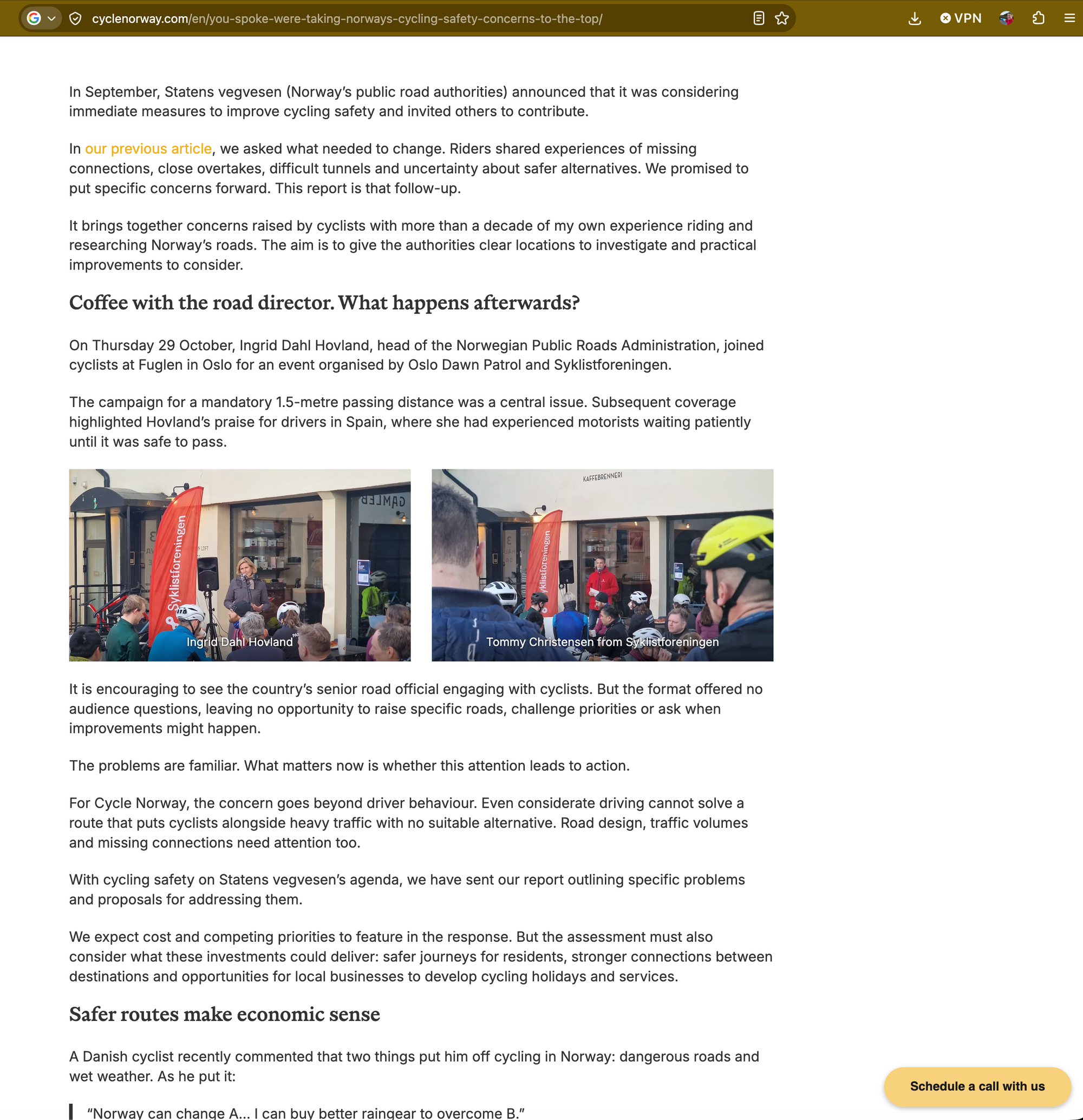
 Norway’s contribution is more geographically dispersed, but the principle is familiar. Cycle Norway’s report responds to a call from the national road authority for ideas on safer cycling. It identifies five priority corridors where cyclists face fast traffic, tunnels, narrow roads or missing links. The report asks authorities to examine options: reconnecting quieter roads, considering separate paths, improving tunnel information, maintaining old bypass roads and trialling e-bike charging.
- It also makes an economic argument. A route that feels unsafe can break an entire holiday itinerary. A missing ten-kilometre connection can mean a visitor never reaches the next town, books no room, buys no lunch and visits no local shop. Better connections could support multi-day cycling holidays and local businesses, while giving residents safer access to neighbouring communities. Cycle Norway is careful to call these proposals starting points for discussion, not finished engineering plans. That is exactly the point: identify the problem, bring the responsible people together, and test what can work.
- Examine the screen-shot of Cycle Norway’s website . . . in the bottom right corner? Note to Luxembourg: let’s make scheduling stakeholder engagement easy as Click the Button.
And then there is Rue des Glacis: the street already has a 30 km/h limit. My neighbours, Kiki and I know the morning, midday and evening reality: cars, SUVs, motorcycles, trucks and buses moving fast enough to make the zebra crossings feel like repeated rounds of the video game Frogger. The Ville de Luxembourg has announced speed bumps, with work scheduled to begin on 17 November. That is welcome. It is also a first baby-step. A painted or posted limit only becomes real when the street’s design and daily driving make it real.
The Y4P Climate Action Tiger is holding up a 30 km/h sign. He has the right idea. Rue des Glacis should feel safe for a child cycling to school, for an older neighbour crossing the road, and for people of all ages and abilities who want to travel by bicycle. No one should need arcade-game reflexes to get across their own street.

That is Decency Infrastructure: the practical choices that show people they count. A safe crossing. A connected cycle route. A bus that moves. A neighbourhood where local businesses can thrive because people can reach them without driving through it.
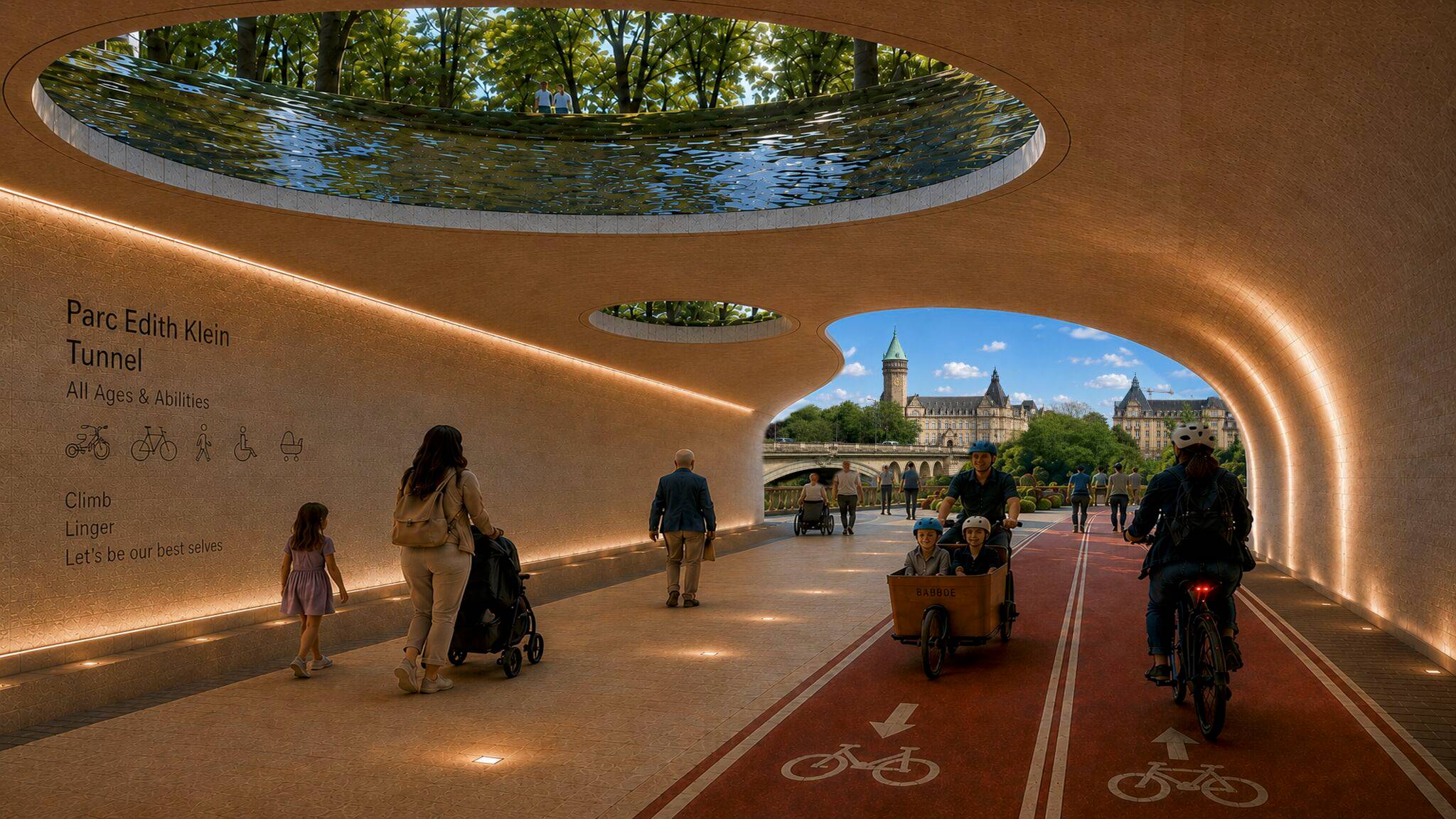
If roughly 2% of Luxembourgers regularly cycle today, the ambition should be to make twenty times as many feel safe and seen enough to do so. In one of Europe’s most 15-minute cities, that should not be a fantasy. It is a question of what we choose to build, protect and prioritise.
Thank you, Sarah and Doug, for the note and for making room for conversations like the one at Hunter College. Thank you to the people in Stockholm and Norway pushing their cities and road authorities to look again at what streets are for. And thank you, Ville de Luxembourg, for taking a first step on Rue des Glacis.
The Universe may be kind. Decency still needs infrastructure.
Further Reading:
- What cities inspire Janette Sadik-Khan? https://blog.ted.com/better-roads-for-bikes-and-walkers-what-cities-inspire-janette-sadik-khan/
- Hunter College: https://www.hunter.cuny.edu/news/the-woman-who-changed-new-yorks-streets-comes-to-hunter-college/
- Ville de Luxembourg Residents survey:
- City of Stockholm proposal to investigate a Traffic Circulation plan. The 2027 budget proposal specifies reducing through-traffic while preserving car access to neighbourhoods; Mitt i describes the Ghent model and its reported outcomes https://start.stockholm/globalassets/start/om-stockholms-stad/sa-anvands-dina-skattepengar/finansborgarradets-forslag-till-budget-2027.pdf
- Norway’s recommendations and their local-business rationale draw on the attached Cycle Norway report and its follow-up: https://cyclenorway.com/en/you-spoke-were-taking-norways-cycling-safety-concerns-to-the-top/